
 ultimate-guide
Scaling Small Restoration Company Operations in 2026
Table of Contents
- Why Scaling Restoration Operations Breaks at 10 to 50 Employees
- Step 1: Build a Cash Flow Model Before You Add Crews
- Step 2: Protect Profit Margins on Every Job
- Step 3: Set 1-3-6 Goals and the KPIs That Track Them
- Step 4: Hire and Keep Technicians While You Grow
- Step 5: Move From Owner-Operator to Manager
- Step 6: Choose the Best AI Tools for Contractors Without Overbuying
- How Restoration Project Management Software Fits Your Tech Stack
- Frequently Asked Questions
Last Updated: September 14, 2026
Why Scaling Restoration Operations Breaks at 10 to 50 Employees
Scaling small restoration company operations is where a business stops being a crew and starts being a company, and where most owners hit a wall. The systems that worked at five employees quietly stop working between 10 and 50 people. This guide from Cortex by JobDox walks through the six moves that separate contractors who scale from those who stall.
The pattern is predictable. At 10 employees, the owner is still the best estimator, project manager, and salesperson in the building. At 25, that stops being possible, and the business either builds management structure or plateaus. Owners describe the same trap: revenue grows, cash tightens, margins slip, and the owner works more hours than ever.
Restoration is document-heavy and deadline-driven. Water losses need moisture logs, contents inventory, and estimate syncing with adjusters, tasks that multiply with every crew you add. Without SOPs, that multiplication turns into chaos.
Step 1: Build a Cash Flow Model Before You Add Crews
Build a cash flow model before you hire anyone. A restoration business can be profitable on paper and still run out of cash: insurance work pays slowly, payroll runs weekly, and equipment purchases land before the job that justifies them.
A working model tracks four things: expected collections by week, payroll and benefits, equipment and vehicle costs, and a reserve for the gap between finishing a job and getting paid. Many owners find the reserve, not the profit line, determines how fast they can add crews.
- Map collections 30, 60, and 90 days out based on your actual carrier payment history
- Build a fixed weekly payroll number before you hire, not after
- Set a minimum cash reserve and treat hiring that dips below it as off the table
- Model one new crew at a time so you can see the cash impact before committing
This is the step most owners skip, and it causes the most damage. Growth eats cash before it produces it.
Step 2: Protect Profit Margins on Every Job
Protect margins by tracking job cost in real time, not after the job closes. The biggest leak is not pricing, it is undocumented scope: drying days that run long, contents handled twice, and equipment left on site past the drying goal.
Restoration project management software that captures moisture logs, photos, and equipment placement as work happens gives you the data to bill what you actually did. When documentation is thin, adjusters cut scope and margin disappears.
Track three numbers on every job: labor hours against estimate, equipment days against the drying plan, and change orders captured before the work happens. Contractors who do this find recovered scope, not higher prices, drives margin improvement.
Step 3: Set 1-3-6 Goals and the KPIs That Track Them
Set goals on a 1-3-6 cadence: what you will accomplish in one month, three months, and six months. Most owners use it as a wish list instead of a sequencing tool. The difference is whether each goal ties to a measurable constraint.
The 1-3-6 framework works because restoration growth has dependencies. You cannot add three crews in month one if dispatching and job tracking cannot handle them, or add any crew if your cash reserve will not cover six weeks of payroll before the first insurance check clears. The one-month goal is usually a system or a hire, the three-month goal a capacity increase, and the six-month goal a revenue or market-positioning target.
| Timeframe | Typical Goal | KPI to Track | Constraint It Relieves |
|---|---|---|---|
| 1 month | Document one core workflow | SOP completion rate | Owner memory |
| 3 months | Add one crew or vehicle | Jobs completed per crew | Capacity |
| 6 months | Enter a new service line | Revenue per job, close rate | Market concentration |
The KPIs That Actually Predict Trouble
Revenue growth, gross margin per job, technician productivity, and client retention cover most of what a growing restoration company needs. But leading indicators matter more than lagging ones when scaling. Track these weekly:
- Estimate-to-actual labor variance. If field hours run more than about 10 percent over estimate consistently, your estimating assumptions are stale, not your crews.
- Days from job completion to invoice sent. Every day between the drying goal and the invoice is a day you are financing the carrier's float. Tightening this single number does more for cash than any collection call.
- Drying days versus drying goal. Jobs that run past the planned drying day are the most common margin leak in water work, and the number is visible in your moisture logs before the job closes.
- Technician turnover (rolling 90-day). If you are losing field staff faster than you can train replacements, no process improvement will hold.
- Backlog in crew-days, not dollars. A dollar backlog hides capacity problems. A crew-day backlog tells you whether you can take the next job.
How to Run the Cadence Without Adding Meetings
Review the 1-3-6 goals in a standing 30-minute weekly meeting with whoever owns operations, plus a 90-minute monthly leadership review. The weekly covers leading indicators; the monthly covers the goals themselves. If a one-month goal slips, do not roll it forward silently, kill it or name the blocker and put it back on the calendar.
The most common failure mode is setting goals that depend on a hire you have not made. If your three-month goal requires a project manager, the one-month goal must be the job posting, interview loop, and offer, not the workflow documentation you would rather do.
Step 4: Hire and Keep Technicians While You Grow
Hire and keep technicians by competing on what larger companies cannot match: clear schedules, real training, and a path to more responsibility. Recruitment and retention is the constraint most owners underestimate, and the one that decides whether growth sticks.
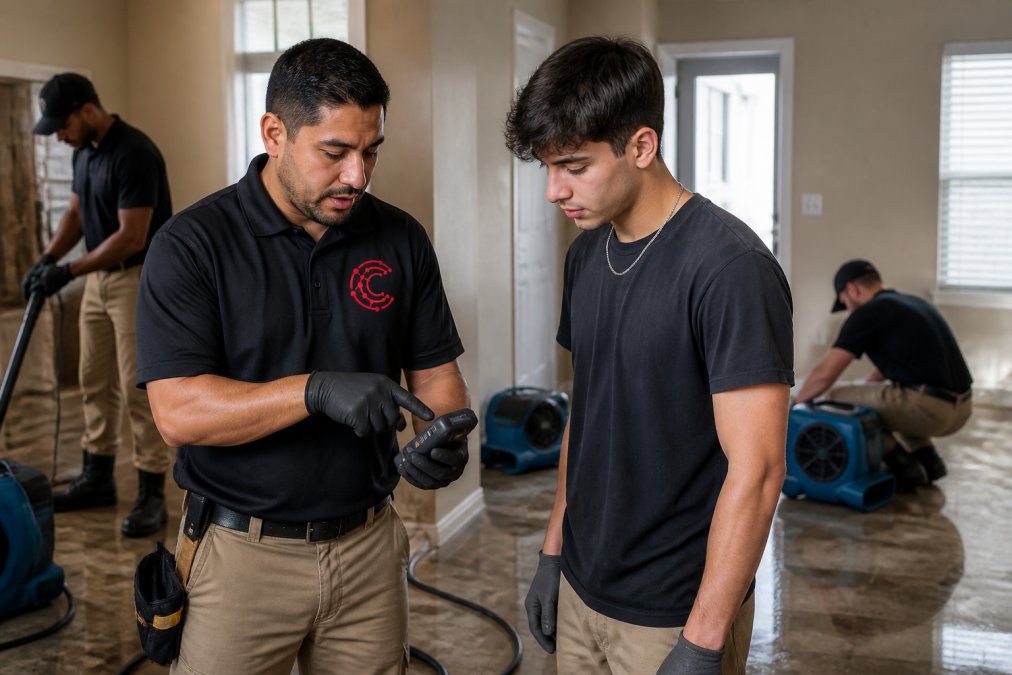
The hiring mistake is recruiting only when desperate. Build a standing pipeline: keep a list of good applicants, offer referral bonuses to current techs, and interview before you have an opening. Retention comes down to predictable hours, working equipment, and a supervisor who does not create chaos.
- Pay competitively for your market and review it at least annually
- Give new techs a written 30-60-90 day training plan
- Promote from within so your best field people see a future
- Fix the scheduling chaos that makes good techs quit
Step 5: Move From Owner-Operator to Manager
Move from owner-operator to manager by replacing your hands with systems and your decisions with delegation. This is the hardest transition in the list because it asks you to give up the work you are best at, and the work that made the business feel like yours.
Most guides treat this as a scheduling problem. It is an identity problem with a scheduling solution. The owner who was the best estimator must become the person who builds estimators, different skills. Companies that stall at 25 employees are usually the ones where the owner never made that shift, even though they hired people who could have absorbed the work.
The Handoff Sequence That Actually Works
Do not try to delegate everything at once. Work through the owner's tasks in this order, one per quarter:
- Estimating. This is usually the easiest to hand off because the output is written and reviewable. Document your estimating assumptions, drying days per category of loss, equipment ratios per square foot, labor hours per room, and have the new estimator produce estimates you review before they go out. Review for 30 days, spot-check for 60, then stop unless the close rate drops.
- Final job review. The owner's job here is to catch missed scope and uncaptured change orders. Turn it into a checklist the project manager completes, and have the PM bring you only jobs that fail a threshold, say, gross margin under target or a change order over a set dollar amount.
- Adjuster negotiation. This is the last thing most owners give up because it is where relationships and revenue live. Hand it off by joining the first ten negotiations the new person runs, then step out. Keep the carrier relationships yourself for the first year; the negotiation can move before the relationship does.
- Hiring and firing. This is the one most owners never delegate, and it is the one that caps growth hardest. A working foreman or operations manager who can hire and coach field staff is the single highest-leverage role in a 25-to-50-person restoration company.
What to Expect During the Dip
Expect a measurable dip in quality for the first month of any handoff. That dip is the cost of building a company that runs without you on every job. Do not read it as evidence the person cannot do it. Give the handoff a full quarter and judge it on metrics, close rate, gross margin, cycle time, not on whether the work looks the way you would have done it.
A common pattern is that the owner takes the work back the first time a customer complains. That single move teaches the whole team that the handoff was not real, and it resets the clock on the transition.
The Structural Shift Nobody Talks About
Scaling past the owner-operator stage requires more than delegation. It requires a management layer, usually an operations manager or general manager, who owns the day-to-day so the owner can own strategy, carrier relationships, and capital decisions. That hire is often the most expensive a small restoration company makes, and usually the one that determines whether the business passes 50 employees.
If you are not ready to make that hire, the honest alternative is to cap growth deliberately and run a smaller, higher-margin company. Both are valid. What does not work is trying to grow past your own capacity while still doing the work yourself.
Step 6: Choose the Best AI Tools for Contractors Without Overbuying
Choose AI tools for contractors by starting with the single workflow that costs you the most time, not with the longest feature list. Most restoration companies do not need five platforms. They need one that handles documentation, scheduling, and job costing together.
The best AI tools for contractors in 2026 do three things well: capture documentation automatically, surface cost overruns before the job ends, and answer plain-English questions about jobs, crews, and finances. Anything beyond that is a nice-to-have until you outgrow the basics.
A common mistake is buying software to fix a process problem. If your dispatching is chaotic because no one owns it, software will just make the chaos faster. Fix the process, then automate it.
How Restoration Project Management Software Fits Your Tech Stack
Restoration project management software is the operational layer tying field work, documentation, and billing together. It is not a replacement for your accounting system or CRM, and not a magic fix for a business with no systems. It is the tool that makes the systems you build hold as you grow.
Cortex by JobDox is an AI-native operations platform built specifically for restoration and service contractors. It automates documentation, predicts project budgets and flags overruns early, drafts adjuster responses to recover more money, and turns completed jobs into a steady referral pipeline. Setup is driven by plain-English descriptions, so you are not rebuilding your workflow from scratch, and Cortex Copilot answers job, crew, and financial questions the way a sharp operations manager would.
For a growing restoration company, the value is not one feature. It is that documentation, budget tracking, and adjuster communication live in one place instead of five. That is what lets a 20-person shop operate like a much larger one without adding overhead.
Scaling a restoration company past 10 or 50 employees is a systems problem, not a hustle problem. The owners who make it build cash flow discipline, protect margin with real documentation, set 1-3-6 goals, hire ahead of need, and hand off the work only they can currently do. Cortex by JobDox was built for exactly this stage: an AI-native platform that automates documentation, predicts project budgets, drafts adjuster responses, and runs on plain-English setup. Start your 14-day free trial and see how it fits your operation.
Frequently Asked Questions
What are the key operational bottlenecks when scaling a restoration company?
The bottlenecks usually show up in four places: cash flow timing (you pay crews and vendors before carriers pay you), dispatch and scheduling (one admin can only juggle so many jobs), documentation (moisture logs and contents inventories pile up), and the owner trying to run every job. Fixing cash flow modeling and moving dispatch to a shared system typically clears the first two before you hire anyone new.
How can restoration companies improve profit margins during growth?
Margin leaks during growth come from three sources: overhead costs that scale faster than revenue, missed line items on estimates, and slow billing recovery from adjusters. Tracking job costing in real time, flagging overruns early, and tightening your documentation so adjusters approve the full scope are the highest-leverage moves. Most contractors find the biggest gain is simply recovering what they already earned but never billed.
Do small restoration companies really need AI tools to scale?
No, but the best AI tools for contractors solve specific bottlenecks that manual processes cannot at 20 or 40 employees. Documentation, estimate syncing, and adjuster communication are the three areas where AI saves the most admin time. If your team is spending more than 10 hours a week on paperwork, the math usually favors adopting a platform. Below that, a spreadsheet and a good SOP may be enough.
How long does it take to implement restoration project management software?
Implementation time depends on the platform. AI-native platforms can cut that substantially by building workflows from a plain-English description of how you already operate. Plan for a two-week pilot on a handful of jobs before rolling out to the full team, and keep your existing admin workflow running in parallel until the new system proves itself.