
 blog
blog
Job Costing vs. Estimating: Key Differences
Table of Contents
- Job Costing and Estimating: What You Need to Know
- Defining Job Costing and Estimating
- A Real Job Costing Example: From Estimate to Final Costs
- Actual Cost vs Estimated Cost: Why They Diverge
- Using a Job Cost Sheet Template to Track Costs
- When Each Process Happens in Your Project Lifecycle
- Job Costing Software: Automating Cost Tracking and Analysis
- Variance Analysis and Corrective Action
- Frequently Asked Questions
Last Updated: October 5, 2026
Job Costing and Estimating: What You Need to Know
Understanding the difference between job costing estimating practices is fundamental to contractor profitability. Cortex by JobDox helps restoration and service contractors who struggle to connect these two processes, and the gap costs them money.
Estimating predicts what a job will cost before work begins; job costing tracks what it actually costs once work is underway. One is a forecast, the other a record, but comparing them reveals where your bids are accurate and where your team is losing margin.
This guide breaks down the distinction and shows how to use both processes together.
Defining Job Costing and Estimating
What Is Job Costing?
Job costing is the process of tracking and recording all actual costs incurred on a specific project. It captures labor hours, materials, equipment, and allocated overhead, with the goal of knowing exactly what a job cost when it's complete.
Job costing happens during and after execution: your team logs hours, you record material purchases and equipment rental or wear, and you end with a complete picture of actual project costs.
This data serves multiple purposes:
- Calculates true project profitability
- Identifies which jobs are profitable and which lose money
- Reveals cost overruns before they spiral
- Provides historical data for future estimates
- Supports billing and insurance claim documentation
Without job costing, you're operating blind. You know what you charged. You don't know if you made money.
What Is Estimating?
Estimating is the process of predicting project costs before work begins. It's your bid, combining labor, materials, equipment, and overhead into a proposal price, your profitability baseline and your commitment to the customer.
Estimating happens before work starts: assess scope, calculate labor hours, price materials, and factor in contingencies. The estimate becomes your project budget.
A solid estimate in job costing estimating:
- Sets a realistic project price
- Provides a budget to manage against
- Identifies scope and resource requirements
- Supports insurance claim negotiations
- Becomes the baseline for variance analysis
The estimate is only useful if it's accurate: a low estimate erodes margin, a high one loses the bid.
A Real Job Costing Example: From Estimate to Final Costs
Here's a water damage restoration project showing how the two work together.
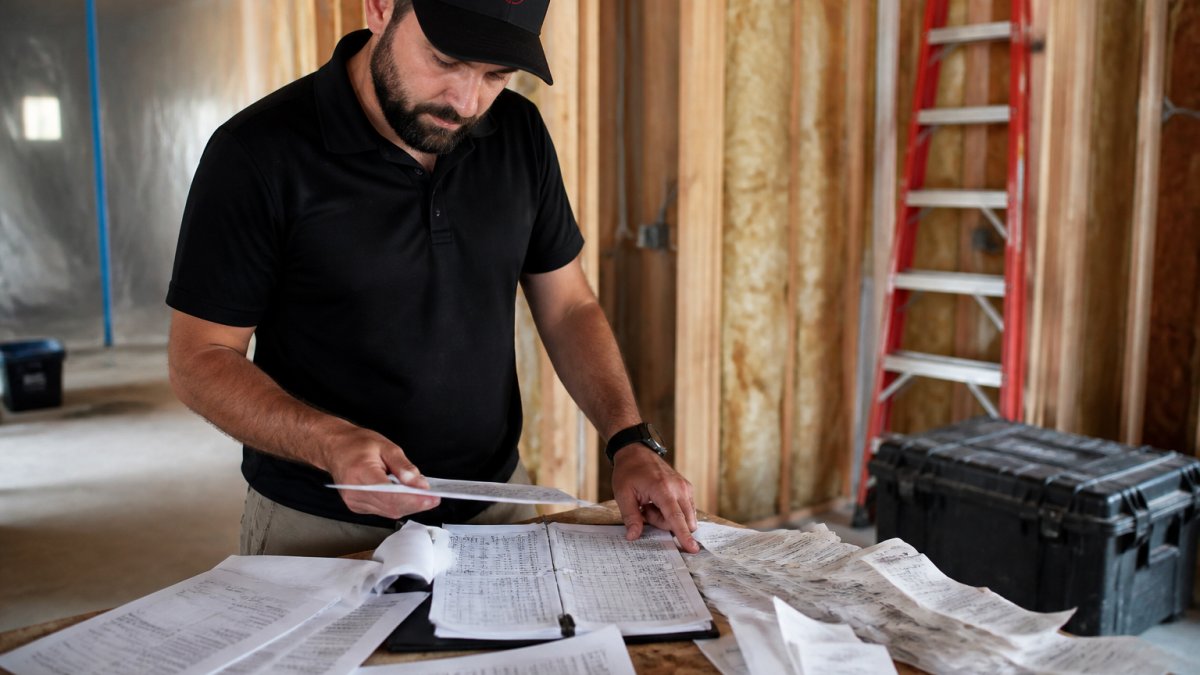
The Estimate: A contractor estimates a residential water mitigation job at 40 labor hours, $8,000 in materials, and $2,000 in equipment rental. Total estimated cost: $18,000. Bid price: $24,000.
During Project Execution: The job takes 52 actual labor hours (not 40). Material costs come in at $8,400 (slightly over). Equipment rental is $2,000 as predicted. Overhead allocation adds another $2,400.
The Job Costing Record: Actual total cost: $20,800. Actual profit: $3,200 (13% margin instead of the 25% projected).
What Happened: The estimate assumed 40 hours; the job required 52. That 12-hour gap cost $1,800 in labor (at $150/hour). The contractor didn't lose money, but margin was half what was planned.
This is where job costing becomes actionable.
Actual Cost vs Estimated Cost: Why They Diverge
Estimated and actual costs rarely match. Understanding why helps you improve future estimates and catch problems early.
Common reasons actual costs exceed estimates:
Labor productivity varies, a new crew member works slower, weather delays the schedule, unforeseen structural issues require different techniques.
Material waste happens on site: you order 500 square feet of drywall and installation waste adds 50 more.
Equipment downtime extends rental periods. A truck breaks down. A piece of equipment fails. You rent a replacement.
Why actual costs sometimes come in lower:
Efficiency gains occur when your team executes faster than estimated.
Bulk discounts kick in: you negotiate better material pricing than the estimate assumed, or use materials already on hand.
Scope is tighter than feared: damage is less extensive than assessed, or the customer skips optional upgrades.
The gap between estimated and actual costs is your variance. Tracking variance over time reveals patterns.
Using a Job Cost Sheet Template to Track Costs
A job cost sheet captures all actual costs for a specific project, organized so you can compare it line-by-line against the estimate.
The sheet only works if every cost lands in the right bucket, that's what cost codes do.
A working job cost sheet includes:
Project information: Job name, customer, contract number, date range, project manager, and original estimate number so the documents stay linked.
Materials: Item description, quantity ordered, quantity used, unit cost, and total. Track ordered-versus-used separately; the gap is your waste factor and should feed future estimates.
Equipment: Type, owned or rented, rental period or internal charge-out rate, and total.
Subcontractors and commitments: Purchase orders and subcontract amounts committed but not yet invoiced.
Overhead allocation: Indirect costs assigned using a consistent basis, commonly a percentage of direct labor or direct cost.
Simple template structure:
| Cost Code | Category | Description | Quantity | Unit Cost | Total |
|---|---|---|---|---|---|
| 02-100 | Labor | Restoration specialist, 40 hrs | 40 | $150 | $6,000 |
| 02-200 | Labor | Equipment operator, 20 hrs | 20 | $125 | $2,500 |
| 09-300 | Materials | Drywall sheets | 50 | $15 | $750 |
| 09-310 | Materials | Adhesive and fasteners | 1 | $200 | $200 |
| 01-400 | Equipment | Dehumidifier rental, 10 days | 10 | $75 | $750 |
| 99-900 | Overhead | Allocated overhead (15% of labor) | , | , | $1,275 |
| Total Actual Cost | $11,475 |
Common data-quality failures that break job cost sheets:
- Inconsistent cost codes. Two PMs use different codes for the same work, so neither job's data is comparable.
- Late time entry. Crews submit hours days later, so the sheet lags reality and overrun alerts arrive too late.
- Omitted overhead. Indirect costs never get allocated, so every job looks more profitable than the business is.
- Unrecorded change orders. Extra work done on a handshake never enters the sheet, so variance looks like a labor problem when it's really a scope problem.
- Commingled materials. A single receipt covers three jobs and gets posted to one, distorting all three.
The job cost sheet becomes your source of truth: what you compare against the estimate, bill the customer from, and archive to improve future estimates.
When Each Process Happens in Your Project Lifecycle
Understanding the timing of estimating and job costing helps you use both effectively.
Pre-project phase (Estimating): Before you bid or accept a job, you estimate: walk the property, assess damage, identify scope, calculate labor and materials, and develop a price.
Project execution phase (Job Costing): Once work begins, job costing starts: crews log hours, you record materials purchased and track equipment use. Job costing happens continuously during the project.
Post-project phase (Variance Analysis): When the job is complete, you compare actual to estimated costs, calculate variance, analyze why it occurred, and use that insight to refine future estimates.
Ongoing improvement: Historical job costing data becomes the foundation for better estimates. A contractor who has completed 30 water mitigation jobs has real data about labor hours, material costs, and equipment needs.
This cycle repeats. Estimate. Execute and track. Analyze variance. Improve the next estimate.
Job Costing Software: Automating Cost Tracking and Analysis
Manual job costing is possible but inefficient. Spreadsheets require data entry. Errors creep in. Information gets lost. Variance analysis becomes a chore instead of a tool.
Job costing software automates the process. Your team logs hours in the field. Materials are recorded when purchased. Equipment rental is tracked automatically. The software calculates actual costs, compares them to estimates, and flags overruns in real time.
Cortex by JobDox predicts project budgets and flags overruns early, so you catch cost problems before they impact profitability. The platform captures labor, material, and equipment data automatically, calculates variance, and provides insights to improve future estimates.
Key features to look for in job costing software:
- Real-time cost tracking across labor, materials, and equipment
- Automatic variance calculation and alerts when actual costs exceed estimates
- Integration with time tracking and material purchasing systems
- Historical data reporting to improve future estimates
- Mobile access so crews can log data on site
- Customizable cost codes and project structures
The right software saves time and improves accuracy, transforming job costing from a post-project accounting task into an active management tool that controls costs during execution.
Variance Analysis and Corrective Action
Variance is the difference between estimated and actual cost. Variance analysis is what you do with that information, and the doing is where most contractors stop short.
A positive variance means actual costs came in under estimate (more margin than planned); a negative variance means they exceeded estimate (less).
How to calculate variance, a worked example.
Take the water mitigation job from earlier.
The job cost sheet at closeout shows 52 labor hours ($7,800), $8,400 materials, $2,000 equipment, and $2,600 allocated overhead, $20,800 total actual cost.
| Line Item | Estimated | Actual | Variance ($) | Variance (%) |
|---|---|---|---|---|
| Labor | $6,000 | $7,800 | +$1,800 | +30% |
| Materials | $8,000 | $8,400 | +$400 | +5% |
| Equipment | $2,000 | $2,000 | $0 | 0% |
| Overhead | $2,000 | $2,600 | +$600 | +30% |
| Total | $18,000 | $20,800 | +$2,800 | +15.6% |
Total cost variance is $2,800 over estimate, or 15.6%. But the line-item view drives action: labor is 30% over, materials only 5%.
Set a threshold before you need it.
Diagnose the cause before you correct it.
Variance has four common root causes, each demanding a different response:
- Estimate error. The labor assumption was wrong, 40 hours was never realistic. Fix: update the estimating database for that job type.
- Execution problem. The estimate was sound but the crew worked slower or reworked a step. Fix: training, crew composition, or scheduling.
- Scope change. Extra work was performed but never captured as a change order. Fix: the change-order process, not the estimate.
- Price movement. Material or equipment costs rose between bid and purchase. Fix: add escalation clauses or shorten the bid-to-start window.
Misdiagnosing the cause is the most expensive mistake in variance analysis.
Corrective actions that actually move the number:
- Update the estimating database. If labor ran 30% over on water mitigation, change the standard hours per unit in your estimating tool, the next bid inherits the correction.
- Adjust contingency for the job type. If a category reliably runs over, build a larger contingency into the estimate rather than pretending the base assumption will hold.
- Tighten the change-order process. Require written approval before extra work begins, and give every change order its own cost code so it never contaminates base-job variance.
- Fix the data capture. If hours are logged late or materials commingled, no analysis will produce a trustworthy variance. Fix the input before trusting the output.
- Review at a set cadence. Weekly during execution for jobs above your threshold, plus a monthly portfolio review to spot patterns no single job reveals.
Track whether the correction worked.
The point of variance analysis isn't the report, it's the next bid. After you adjust, monitor variance on the next five jobs of the same type.
Frequently Asked Questions
What is the difference between costing and estimation?
Estimation predicts project costs before work begins, based on scope, materials, and labor assumptions. Job costing records and analyzes actual expenses incurred during the project. Estimation helps you bid and budget; job costing shows what the work actually cost and reveals profitability. Both are essential, estimation wins the job, job costing controls it.
What is an example of job costing?
A water damage restoration project estimated at $8,000 might include $2,500 in labor, $3,000 in materials, and $2,500 in equipment. As work progresses, you track actual labor hours, material usage, and equipment rental. If actual costs total $9,200, the variance of $1,200 over budget signals where overruns occurred, labor, materials, or both, so you can adjust future estimates and pricing.
How can contractors compare estimated costs with actual costs?
Use a job cost sheet or job costing software to record all direct labor, materials, and equipment expenses against the original estimate line by line. Calculate the variance (actual minus estimated) for each cost category. A positive variance means you spent more than estimated; negative means you spent less. Review variances monthly to spot trends, if labor consistently exceeds estimates, your bid rates or crew efficiency may need adjustment.
Why do estimates and final job costs differ?
Scope changes, unforeseen conditions, labor inefficiencies, material price fluctuations, and equipment downtime all drive variance. A water damage job might uncover hidden mold, requiring extra labor and materials not in the original estimate. Tracking these differences through job costing helps you refine future estimates, adjust pricing to protect profit margins, and identify operational inefficiencies to correct.