 how-to
Why Restoration Companies Struggle to Scale
Table of Contents
- The Scaling Wall: Where Restoration Companies Hit Their Ceiling
- Why Growth Stalls at 15-30 Employees: The Owner Dependency Trap
- How to Grow a Restoration Business Without Burning Out Your Team
- Restoration Contractor Project Management: The Scheduling and Coordination Breakdown
- Restoration Business Profitability: Why Margins Shrink as You Grow
- AI Tools for Restoration Contractors: Automating Your Way Through the Scaling Bottleneck
- Your Measurable Scaling Roadmap: From 20 to 50 Employees
- Frequently Asked Questions
Last Updated: October 13, 2026
The Scaling Wall: Where Restoration Companies Hit Their Ceiling
Most restoration companies hit a hard ceiling around 15 to 30 employees. Growth stops. Profit margins shrink. Owner burnout accelerates. Understanding why restoration companies struggle to scale reveals the problem isn't demand, it's operational capacity.
Why restoration companies struggle to scale comes down to three interconnected failures: dependency on the owner, broken project workflows, and margin compression. These aren't management problems. They're structural problems baked into how restoration work operates.
At Cortex by JobDox, we've worked with hundreds of restoration contractors facing this exact wall. The companies that break through it share one thing in common: they stop trying to do more with the same system and instead rebuild the system itself.
This guide walks you through why growth stalls, where your operation breaks first, and the specific roadmap to scale past 50 employees without collapsing your margins or your team.
Why Growth Stalls at 15-30 Employees: The Owner Dependency Trap
The owner becomes the bottleneck. Not because the owner is lazy or unwilling to delegate. Because the business was built around the owner's judgment, relationships, and decision-making.
Early on, this works. The owner estimates jobs, builds client relationships, handles adjuster negotiations, and manages crew leaders. Everything flows through one person. That person is good at it. Clients trust that person.
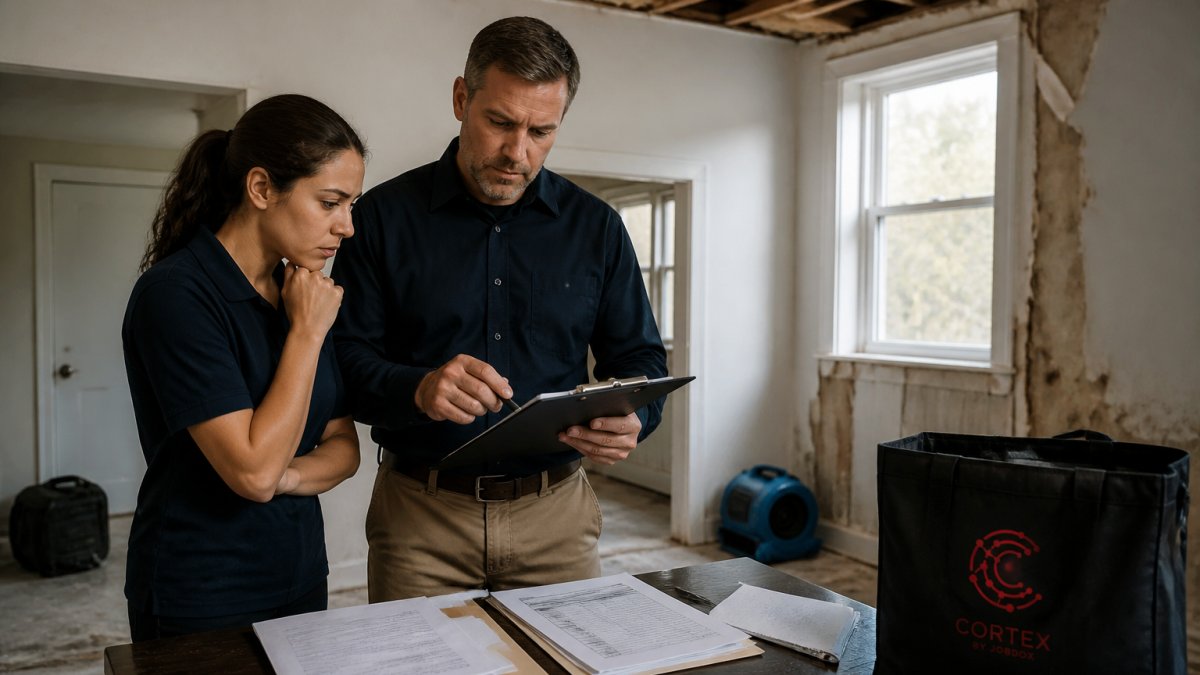
Then you hit 15 employees. You've hired a project manager. You've got two crews. But the owner still estimates every job. Still takes the big adjuster calls. Still approves every scope change. The owner is now the constraint on growth.
Scaling past this point requires a hard choice: rebuild the business so it doesn't depend on the owner's presence. That means documented processes, trained estimators, delegated authority, and systems that enforce consistency when the owner isn't in the room.
Most restoration companies try to add staff instead. They hire more estimators, more project managers, more office people. But without systems in place, those new hires still funnel decisions back to the owner. You've just added payroll without adding capacity.
How to Grow a Restoration Business Without Burning Out Your Team
Sustainable growth requires three operational shifts:
1. Document your estimating process. Not a general guide. Your specific process. How do you price water damage? How do you account for hidden mold? What's your markup on materials? What contingency do you build in? Write it down. Train your estimators to follow it. Then measure how often their estimates match actual job costs.
2. Build crew scheduling around capacity, not availability. Most restoration companies schedule jobs based on crew availability. That's backwards. You should schedule based on crew capacity and job complexity. A crew of four can handle two concurrent jobs if one is straightforward water mitigation and the other is mold remediation. But they can't handle two mold jobs at once. Your scheduling system needs to know the difference.
3. Automate the communication that steals your time. Adjuster emails. Photo uploads. Site reports. Scope confirmations. These aren't strategic decisions. They're information flows. Every hour your team spends on manual communication is an hour they're not on the job or managing the next job. Automation here doesn't mean "set it and forget it." It means your system drafts the response, flags it for review, and sends it automatically once approved.
The companies that scale fastest don't work harder. They work smarter by automating the work that doesn't require human judgment and building systems that push judgment to the person closest to the decision.
Restoration Contractor Project Management: The Scheduling and Coordination Breakdown
Project management in restoration is uniquely hard because the work is unpredictable. A water mitigation job that should take three days might take five if the humidity won't drop. A mold remediation can hit unexpected contamination. Weather delays everything.
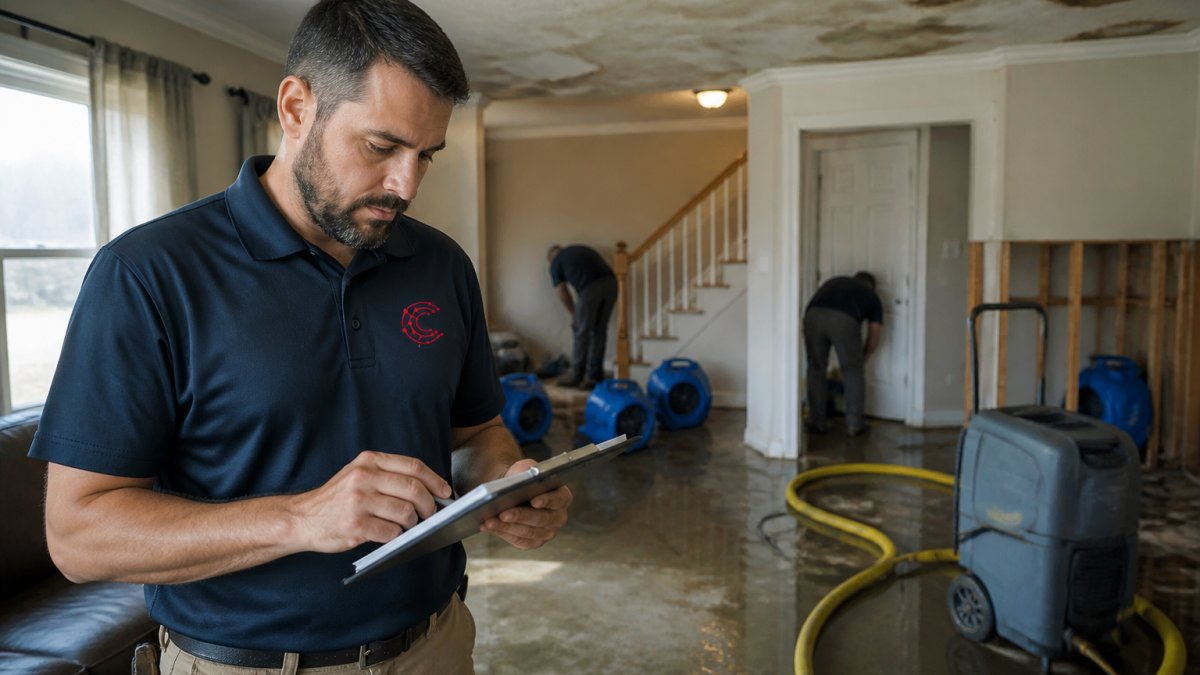
Most restoration companies manage this with phone calls and text messages. The project manager calls the crew. The crew reports back. The project manager updates the office. The office updates the adjuster. Information moves slowly. Decisions lag. Jobs overlap or sit idle.
The fix is a scheduling system that shows real-time crew location, job status, and available capacity. When a new urgent job comes in, you can see immediately which crew can absorb it without overcommitting.
This sounds like a software problem. It's actually a workflow problem that software solves. You need:
- Real-time job status updates (not end-of-day reports)
- Crew capacity visibility (how many jobs can one crew run in parallel)
- Automated alerts when jobs slip or conflict
- One source of truth for schedule changes (not email threads)
Without this, you're managing by exception. A job runs over. You scramble. You pull a crew from another job. That job slips. You hire more staff to cover the gap. Margins shrink because crews are underutilized.
Restoration Business Profitability: Why Margins Shrink as You Grow
Here's the hard truth: most restoration companies see margins compress as they grow from 10 to 40 employees. Revenue increases. Profit per job decreases.
This happens for three reasons:
Overhead creep. You add a project manager, then an office manager, then an estimator. Each hire is justified. But suddenly your overhead is 35% of revenue instead of 20%. You need higher margins to cover it. But you're not charging higher prices, you're just paying more people.
Scope creep on jobs. As you grow, you take on more complex jobs. More variables. More unknowns. Your estimators haven't been trained to account for the complexity. Jobs run over budget. You eat the loss or negotiate a lower payout with the adjuster.
Crew inefficiency. Larger crews don't work harder or faster. They work slower. More communication overhead. More standing around waiting for direction. A crew of three moves faster per person than a crew of six.
The companies that maintain margins as they scale do three things:
-
Track job profitability obsessively. Not just revenue. Profit per job. Gross margin per job type. You need to know which jobs make money and which ones don't. Most restoration companies can't answer this question.
-
Price for complexity, not just materials. A straightforward water mitigation gets one price. A job with hidden mold, structural damage, and insurance disputes gets a different price. Your estimating process should automatically adjust for complexity.
-
Right-size your crews. Smaller, focused crews beat large crews every time. A crew of four handling one job beats a crew of six handling two jobs. The four-person crew finishes faster, has higher quality, and costs less per job.
Tools like Cortex by JobDox help here because they predict project budgets and flag overruns early. You see which jobs are drifting into loss territory before they finish. You can course-correct mid-job instead of discovering the problem after the invoice is sent.
AI Tools for Restoration Contractors: Automating Your Way Through the Scaling Bottleneck
The restoration industry is finally adopting AI tools. Not because AI is trendy. Because the work has become too complex to manage manually.
AI in restoration does three specific things:
Predicts project budgets. The system learns from your historical jobs. It knows how long drying takes in humid climates. It knows which property types hide mold. It knows your crew's actual productivity rates. When you estimate a new job, the system flags if your estimate is an outlier compared to similar jobs. You catch the underestimate before you bid it.
Automates adjuster communication. Adjusters want photos, reports, and scope updates. Your team spends hours organizing and sending these. An AI system drafts the email, attaches the photos, and flags it for approval. Your admin person reviews it in two minutes instead of spending 45 minutes building the email from scratch.
Manages documentation automatically. Photos get tagged with job, location, and date automatically. Reports get generated from site data instead of typed manually. The system knows which documents the adjuster needs and flags missing ones before you submit.
The key word is "automatically." Not "magically." The system doesn't replace your team. It removes the manual work so your team can focus on judgment calls and client relationships.
Cortex by JobDox is built specifically for this. It automates documentation, predicts project budgets, and drafts adjuster responses. The platform learns your business rules and applies them consistently across every job. No lengthy implementation. You describe your process in plain language and the system builds the workflows.
Your Measurable Scaling Roadmap: From 20 to 50 Employees
Scaling from 20 to 50 employees requires a staged approach. Not a big bang.
Phase 1: Months 1-3, Establish baseline metrics.
Track these numbers for every job:
- Actual vs. estimated hours
- Actual vs. estimated materials cost
- Job profitability (revenue minus direct costs)
- Crew use (billable hours divided by total hours)
- Days from job completion to payment
You can't improve what you don't measure. Most restoration companies don't know their actual job profitability. They know revenue. They don't know profit.
Phase 2: Months 4-6, Automate communication workflows.
Start with adjuster communication. Document your current process. Map out every email, photo set, and report you send adjusters.
This frees up 10-15 hours per week of admin time. That's one person's worth of capacity without hiring anyone.
Phase 3: Months 7-9, Implement project scheduling.
Replace your current scheduling system (phone calls, spreadsheets, text messages) with a real-time scheduling tool. Train your project managers to use it.
Phase 4: Months 10-12, Standardize estimating.
Document your estimating process. Train new estimators to follow it. Measure how often their estimates match actual costs.
This is the hardest phase because it requires the owner to step back from estimating and trust the process.
| Phase | Timeline | Focus | Expected Result |
|---|---|---|---|
| Baseline | Months 1-3 | Measure job profitability | Know which jobs make money |
| Automation | Months 4-6 | Eliminate manual communication | Free 10-15 hours/week |
| Scheduling | Months 7-9 | Real-time crew management | 10-15% higher crew use |
| Estimating | Months 10-12 | Standardize pricing process | Owner dependency reduced |
Scaling a restoration company is possible. It's not easy, but it's predictable. The companies that scale successfully don't do more.
Start 14-day free trial with Cortex by JobDox and see how automating your documentation and project workflows removes the bottlenecks that slow growth.
Frequently Asked Questions
Why do restoration companies struggle to grow beyond 20-30 employees?
Most restoration companies hit a growth ceiling when the owner can no longer manage every job personally. Communication breaks down, scheduling conflicts multiply, and crews waste time waiting for approvals or missing adjuster deadlines. The business outgrows manual processes but lacks systems to replace the owner's oversight. Without delegation frameworks and automated workflows, adding more employees actually reduces profitability rather than increasing it.
How can restoration contractors improve profitability while scaling?
Profitability shrinks during scaling because labor costs rise faster than revenue. The fix requires three moves: (1) Standardize job estimating so crews stop underpricing work. (2) Track unit economics per job type to identify which services are actually profitable. (3) Automate administrative work, scheduling, insurance adjuster communication, and documentation, so your team spends time on billable work, not paperwork. Most restoration businesses can recover lost overhead and labor inefficiencies through operational discipline.
What role do AI tools play in helping restoration companies scale?
AI tools for restoration contractors automate three critical scaling bottlenecks: documentation (photos, estimates, adjuster reports), project budgeting (flagging cost overruns before they happen), and scheduling (optimizing crew assignments and reducing travel time). Rather than hiring more admin staff, AI handles repetitive work in minutes. This frees your team to focus on customer service, job quality, and business development, the activities that actually drive growth and customer trust.
How does restoration contractor project management change as you scale?
At 10 employees, one person manages all jobs. At 30 employees, you need crew leads, real-time job visibility, and automated handoffs between teams. Restoration contractor project management at scale requires: centralized scheduling that prevents double-booking, mobile access so crews see updates on-site, automated alerts when jobs run over budget, and clear escalation paths for insurance claim issues. Without these systems, communication failures and missed deadlines multiply faster than revenue grows.