 listicle
Best Restorator Pro Alternatives for 2026
Table of Contents
- Why Restoration Contractors Switch From Restorator Pro
- Restorator Pro Alternatives: Feature Comparison Table
- Restoration Business Workflow Automation: What Modern Platforms Offer
- How to Automate Restoration Documentation With These Tools
- Restoration Contractor Software Pricing and Implementation
- Top Alternatives Ranked by Use Case
- Making the Switch: Data Migration and Onboarding
- Conclusion
- Frequently Asked Questions
Last Updated: September 18, 2026
Why Restoration Contractors Switch From Restorator Pro
Restoration contractors outgrow their existing software when documentation becomes manual, budgets slip without warning, and adjusters request the same information repeatedly. Restorator Pro alternatives for 2026 exist because the industry has evolved. Field teams now expect mobile-first tools. Project managers need real-time visibility into costs. Office staff are tired of data entry.
The shift isn't about one missing feature. It's about workflow friction. A contractor managing 15 active jobs can work around clunky interfaces. At 40 jobs, that friction becomes a cost center. Time spent hunting for photos, re-entering data, or manually drafting adjuster responses is time not spent on billable work.
Cortex by JobDox was built specifically to address this friction. The platform automates the workflows that consume the most time: documentation capture, budget prediction, and adjuster communication. Contractors switching from legacy systems report that setup takes days, not months, because workflows build themselves based on plain English descriptions rather than requiring IT configuration.
The real reason contractors evaluate alternatives comes down to three things: they want documentation to happen automatically on job sites, they want to know if a project is heading over budget before it happens, and they want their admin staff focused on recovery rather than data management.
Restorator Pro Alternatives: Feature Comparison Table
| Platform | Best For | Key Strength | Mobile Documentation | Budget Prediction | Adjuster Communication |
|---|---|---|---|---|---|
| Cortex by JobDox | Growing restoration companies 15-50 employees | AI-native automation + budget forecasting | Yes, mobile-first | Yes, AI-driven | Yes, automated drafts |
| DASH by Next Gear | Large enterprises requiring Xactimate integration | Enterprise job management at scale | Yes | Limited | Manual |
| Encircle | Field documentation speed and accuracy | 360-degree capture and floor plans | Excellent | No | No |
| Simpro | Complex projects with inventory tracking | Job costing and supply chain management | Yes | Yes | Manual |
| Contractor+ | Solo contractors and small teams | Budget-friendly mobile estimates | Yes, simple | No | No |
| DocuSketch | Insurance claim visualization | 360 virtual tours and Xactimate integration | Yes | No | No |
| JobNimbus | Sales-focused contractors | CRM and pipeline customization | Yes | No | Manual |
Restoration Business Workflow Automation: What Modern Platforms Offer
Workflow automation in restoration software means different things depending on what's being automated. The best platforms handle three core workflows: capturing field documentation without manual steps, predicting project costs as work progresses, and managing communication with insurance adjusters.
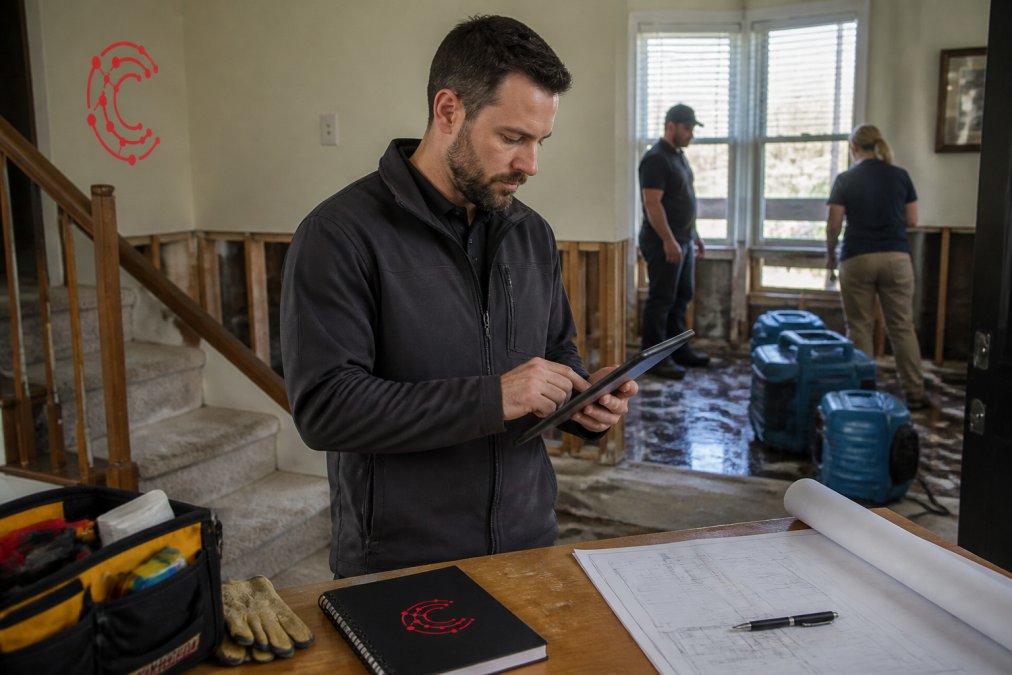
Field documentation automation starts with the mobile app. A technician arrives at a water damage site and opens the app. Photos are geotagged and timestamped automatically. Notes sync to the cloud without manual uploads. Floor plans generate from measurements captured on site. The office team never asks "Did you get photos of that wall?" because the system shows exactly what's been documented in real time.
Budget prediction requires the platform to learn what typical restoration work costs. As jobs complete, the system tracks actual hours, materials, and outcomes. When a new job starts, the platform flags if the estimated budget seems low based on similar past jobs. This early warning prevents the common scenario where a project runs 30% over budget and the contractor absorbs the loss because the adjuster won't approve supplements retroactively.
Adjuster communication automation handles the repetitive back-and-forth. An adjuster requests updated photos. The platform knows which photos exist, which are most recent, and which show the relevant damage. It drafts a response with the right photos attached. The admin approves and sends. What normally takes 20 minutes takes 2 minutes.
Cortex by JobDox automates all three workflows through its AI-native architecture. The Cortex Copilot answers questions about job status, crew productivity, and financial performance in plain English. Instead of logging into dashboards, a project manager asks "Which jobs are tracking over budget?" and gets an immediate answer.
How to Automate Restoration Documentation With These Tools
Documentation automation requires three components: a mobile app that captures data on site, cloud storage that syncs without manual uploads, and a system that organizes what's captured so it's findable later.
Start with the mobile app. The best tools in this category have offline capability. A technician working in a basement with poor signal should still be able to take photos and notes. Once the device reconnects, everything syncs automatically. This prevents the scenario where field teams return to the office and spend an hour uploading and organizing photos manually.
Next, ensure the system captures metadata automatically. Photos should include timestamp, GPS location, and which job they belong to. Notes should be searchable. This metadata is what makes documentation useful. A photo with no date and no location is just a picture. A photo with timestamp and GPS location is evidence that can be used in an adjuster conversation.
Third, build a workflow for organizing what's captured. The platform should sort documentation by job, by room, by damage type, or by date depending on what the team needs. A technician shouldn't have to think about folder structure. The app should ask "What room is this?" and file it correctly.
Restoration Contractor Software Pricing and Implementation
Pricing for restoration software falls into three categories: free or freemium models for solo contractors, mid-market subscriptions for 10-50 person teams, and enterprise licensing for larger operations.
Freemium platforms like Contractor+ start at no cost and scale as you add users or features. This works well for contractors with fewer than 5 employees. The trade-off is limited reporting, no budget prediction, and basic mobile functionality.
Mid-market platforms typically require contacting the vendor for pricing because the cost depends on the number of users, jobs, and integrations.
Cortex by JobDox offers a free trial so you can test the platform before committing. Pricing is available on the website. The key difference from competitors is the onboarding approach. Most platforms require your team to learn the software. Cortex by JobDox builds your workflows automatically based on how you describe your business.
Implementation friction matters more than most contractors realize. This is where Restorator Pro alternatives differ most visibly. Some require extensive configuration. Others, like Cortex by JobDox, start working the day you sign up.
Top Alternatives Ranked by Use Case
For AI-Driven Budget Prediction and Automation: Cortex by JobDox
Cortex by JobDox stands out because it was built specifically for restoration contractors, not adapted from generic field service software. The platform automates documentation, predicts budget overruns before they happen, and drafts adjuster responses. Setup happens in days because workflows build themselves based on plain English descriptions of how you work. The Cortex Copilot answers questions about job status and crew performance without requiring users to navigate dashboards. For contractors tired of manual processes and spreadsheet-based budget tracking, this is the clearest path forward.
For Enterprise Scale and Xactimate Integration: DASH by Next Gear
DASH is the choice for large restoration companies with complex operations and deep Xactimate integration requirements. The platform handles job management at enterprise scale with advanced reporting that shows profitability by job type, crew, and service line.
For Field Documentation Speed: Encircle
Encircle solves one problem exceptionally well: capturing field documentation quickly and accurately. The 360-degree photo capture and automated floor plan generation are faster than traditional approaches.
For Complex Job Costing: Simpro
Simpro excels at project management and job costing for contractors handling complex work. The platform tracks materials, labor, and overhead by job with detailed financial reporting. Inventory management is built in, which matters for contractors with warehouse operations.
For Budget-Conscious Solo Contractors: Contractor+
Contractor+ offers a free tier and keeps pricing low. The mobile app is clean and simple. Estimates and invoices generate quickly. This platform works well for contractors with fewer than 5 employees who need basic job and client management without complexity.
For Insurance Claim Visualization: DocuSketch
DocuSketch specializes in creating 360-degree virtual tours and floor plans from field captures. Adjusters appreciate the visual clarity. The platform integrates with Xactimate, which matters if your estimating workflow depends on that system.
For Sales Pipeline Management: JobNimbus
JobNimbus is built around CRM and sales pipeline management.
Making the Switch: Data Migration and Onboarding
Switching platforms requires three decisions: whether to migrate historical data, how much retraining your team will tolerate, and how long you can afford disruption.
Historical data migration is optional but usually worth doing. Most contractors want to keep records of past jobs for reference and financial tracking. The migration process varies by platform.
Disruption is real. This is why implementation speed matters.
Conclusion
Restoration contractors evaluating Restorator Pro alternatives are typically facing the same problem: their current system doesn't scale with their business. Documentation is still manual. Budget visibility is limited. Adjuster communication is time-consuming. The platform that solves this fastest is the one built specifically for restoration work.
Frequently Asked Questions
What are the main reasons contractors leave Restorator Pro for alternatives?
Contractors typically switch when they need AI-driven budget prediction, automated adjuster communication, or integrated job scheduling that Restorator Pro doesn't provide. Many also cite limited mobile functionality, steep learning curves for new team members, and difficulty scaling workflows as operations grow. Platforms like Cortex by JobDox address these gaps with plain-English workflow automation and real-time job costing visibility that restoration teams find more intuitive.
How does restoration business workflow automation reduce overhead costs?
Workflow automation eliminates manual data entry, reduces administrative time, and flags budget overruns before they become costly mistakes. By automating documentation capture, scheduling, and adjuster communication, restoration contractors can boost profitability by reducing overhead and labor inefficiencies. Automated workflows also ensure consistent processes across teams, reducing rework and accelerating job completion, which directly improves profitability.
What should I expect to pay for restoration contractor software in 2026?
Restoration contractor software pricing varies widely based on team size, features, and deployment model. Some platforms offer free tiers for small teams, while enterprise solutions require custom quotes. Visit each vendor's pricing page for current rates. Many platforms offer free trials so you can test functionality before committing. Consider total cost of ownership, including implementation and training, not just monthly fees.
How long does it take to migrate from Restorator Pro to a new platform?
Migration time depends on data volume and complexity. Many platforms offer white-glove onboarding to accelerate the process and reduce disruption to active jobs. Plan data cleanup before migration, train your team on new workflows in parallel, and run both systems briefly during transition to catch gaps.