
 ultimate-guide
How to Generate Restoration Leads: 7 Proven Channels
Table of Contents
- The 7 Channels That Actually Generate Restoration Leads
- Plumber Referral Scripts for Restoration That Convert
- Water Damage Lead Generation Strategies for Emergency Calls
- Improving Insurance Claim Documentation Speed to Win More Jobs
- Lead Qualification, CRM Tracking, and Conversion
- What Restoration Leads Cost and How to Budget
- Post-Disaster Reputation Management and Repeat Business
- Frequently Asked Questions
Last Updated: September 26, 2026
The 7 Channels That Actually Generate Restoration Leads
Most restoration contractors chase the same channels and wonder why the phone stays quiet. Generating restoration leads is not about spending more; it is about building a system where emergency calls, referral partners, and repeat business feed each other. This guide from Cortex by JobDox breaks down seven channels that work for small and mid-sized firms.
| Channel | Setup Effort | Ongoing Cost | Best For |
|---|---|---|---|
| Plumber and trade referrals | Low | Relationship time | Steady, qualified jobs |
| Local Service Ads and Google Business Profile | Medium | Pay per lead | Emergency calls |
| Insurance adjuster networking | Medium | Relationship time | Larger claims |
| Website and landing pages | Medium | Hosting, updates | Inbound credibility |
| Content and SEO | High | Content production | Long-term pipeline |
| Direct mail and door hangers | Low | Print and postage | Storm-affected areas |
| CRM and follow-up automation | Medium | Software subscription | Conversion and repeat work |
Plumber Referral Scripts for Restoration That Convert
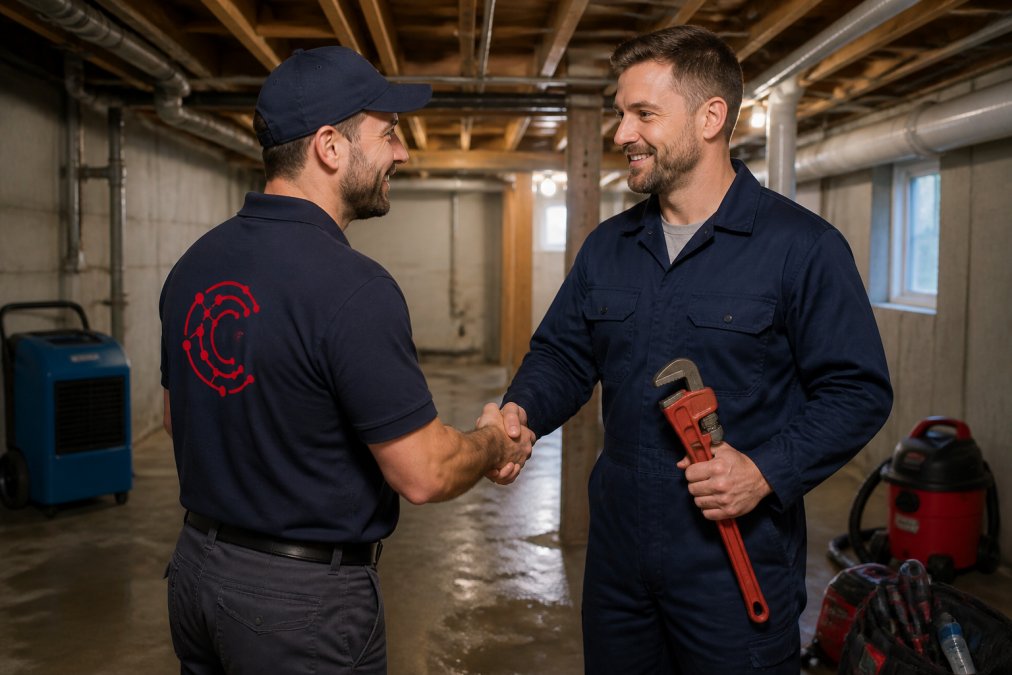
Plumbers are the best referral source for water damage work because they see the leak before it becomes a claim. The trick is a script that makes the handoff effortless, not asking for "any leads."
The 30-Second Counter Script
"I've got a restoration crew I trust who can be here within the hour and handle your insurance paperwork. Want me to call them right now?"
Keeping the Pipeline Warm
Referral relationships decay fast. Text your top five plumbers every two weeks with a job update or thank-you, and send a small gift card for jobs over a certain size.
Water Damage Lead Generation Strategies for Emergency Calls
Emergency work rewards speed above all. Water damage lead generation strategies that work put your business in front of a panicking homeowner within minutes of their search. The common mistake is optimizing for cost per lead instead of cost per booked job.
Local Service Ads and Google Business Profile
Local Service Ads put your business at the top of search results and charge per qualified lead rather than per click. Pair that with a fully built-out Google Business Profile, complete with service categories, photos of completed jobs, and a service area that matches where you actually drive. According to Google's guidance on Local Services Ads, verification and license checks are required before ads go live, so start that process early.
Landing Pages and Response Times
Every paid campaign needs a dedicated landing page with one job: get the phone to ring. Put your number at the top, remove navigation, and add a short form for after-hours leads. Response time is the whole game, contractors who call back within five minutes book far more jobs than those who wait an hour.
Improving Insurance Claim Documentation Speed to Win More Jobs
Improving insurance claim documentation speed is the quietest competitive advantage in restoration. Adjusters assign work to contractors who make their job easy, and a clean, fast file signals that. CRM integration and lead management matter more than marketing spend.
A practical system looks like this:
- Capture photos and moisture readings on arrival, tagged by room
- Log the cause of loss and date of discovery immediately
- Upload the signed work authorization before leaving the site
- Send a scope summary to the adjuster within 24 hours
- Track every adjuster response in one shared pipeline
Lead Qualification, CRM Tracking, and Conversion
-
Urgency: Is water or sewage actively entering the structure right now? Active intrusion means dispatch immediately, even at 2 a.m. Standing water that has been there for three days is urgent but not an emergency, schedule the inspection for the next business window.
-
Coverage: Do they have a homeowner's or commercial policy, and have they filed a claim yet? If they have not filed, you can often help them document the loss before they call the carrier, which builds loyalty and gives you control of the file.
-
Scope: Is this one room or the whole first floor? A single-room extraction is a different crew, a different truck, and a different margin than a category 3 flood across 3,000 square feet.
-
Active intrusion + covered: dispatch now, notify the on-call estimator.
-
Active intrusion + not covered: quote and schedule within 24 hours; these are cash jobs and they close fast if you are responsive.
-
Not active + covered: schedule an inspection within 48 hours and start the claim documentation.
-
Not active + not covered: enter a nurture sequence. These are the leads most contractors throw away and later wish they had kept.
-
Web forms: Connect your landing page form directly to your CRM or field management software via a native integration or a webhook. Do not route form submissions to a personal email inbox. If your form tool does not integrate, use a middleware connector so the lead lands as a record with a stage and an owner, not an email.
-
Phone calls: Use a call-tracking number per channel so the CRM logs the source automatically. If a call comes in after hours, it should create a lead record with a 'call back' task assigned to the on-call person, not a voicemail nobody checks until morning.
-
Lead marketplaces: Most shared-lead platforms push leads via email or API. If they offer an API, use it. If they only send email, set up a parsing rule that creates a CRM record and fires an SMS alert to the on-call estimator within seconds.
-
Referral partners: Give plumbers and adjusters a dedicated intake number or a one-tap form so their referrals land in the same pipeline as everything else. If their referrals come in as a text to your personal cell, you have no data on them.
One practical test: ask your project manager to name every lead not contacted in the last 48 hours. If they cannot answer in under a minute, your leads are leaking.
What Restoration Leads Cost and How to Budget
- Cost per lead (CPL): what you pay to get the phone to ring or the form to submit.
- Cost per booked job: CPL divided by your lead-to-booking rate.
- Cost per won job (CPA): booked jobs divided by jobs you actually complete and collect on. This is the only figure that belongs in a budget.
- Set a target CPA before you spend a dollar. Work backward from your average job value and target gross margin. If your average water damage job nets a healthy margin, you can afford a CPA that would bankrupt a company chasing $400 carpet cleans. Never let a channel's CPL set your budget; let your CPA ceiling set it.
- Fund owned channels first. Referral programs, Google Business Profile, and review generation cost time, not ad spend, and they compound. Fund them to the ceiling of your capacity before you scale paid.
- Cap paid channels at a fixed monthly number and measure CPA weekly, not monthly. A channel that misses your CPA ceiling for two consecutive weeks gets paused, not 'given more time.'
- Keep one experimental channel at a small fixed spend. This is how you find the next plumber-partnership equivalent before your competitors do.
- Reconcile CPA against collected revenue, not invoiced revenue. Restoration has supplements, change orders, and disputed scopes. A job that invoices at one number and collects at a lower one has a higher real CPA than your spreadsheet shows.
Do not benchmark against a national average from a blog post, your market, average job size, and close rate make published figures useless. The benchmark that matters is your own CPA trend line. If it is climbing in a channel you have run for six months, the channel is saturating; shift budget.
Post-Disaster Reputation Management and Repeat Business
For contractors who want the operational side handled, Cortex by JobDox converts won jobs into search-optimized local landing pages automatically and drafts adjuster responses to help recover more money, which frees your team to focus on the work itself. You can compare current plans and start a free trial on the Cortex by JobDox site.
Frequently Asked Questions
What is the most effective way to generate restoration leads?
Referral partnerships with plumbers and insurance adjusters drive the highest-quality restoration leads because they arrive pre-qualified. Pair that with a strong local search presence through Google Business Profile and local service ads to capture emergency searches. Most successful contractors combine two or three channels rather than relying on one. The key is tracking which sources produce jobs you actually close, then shifting budget toward those.
Is buying restoration leads worth the cost for small contractors?
It depends on your close rate and customer acquisition cost. Shared leads sold to multiple contractors often cost $50 to $150 each, and you may win only one in five. Exclusive leads cost more but convert better. For a small crew, buying leads can fill gaps during slow weeks, but the margins shrink fast if you cannot answer calls within minutes. Calculate your cost per booked job before committing to a lead vendor.
How can restoration companies build long-term referral partnerships with plumbers?
Start by solving a problem for the plumber, not asking for one. Offer to handle the water extraction and drying so the plumber can move to the next job. Give them a simple script or card to hand homeowners, and pay referral fees where legal in your state. Follow up after every job with a thank-you and a status update. Consistency matters more than the size of the fee.
How does accurate insurance documentation improve lead conversion rates?
When you can produce a complete, photo-documented scope within hours of the site visit, adjusters approve faster and homeowners see progress. That speed builds trust during the sales conversation. Contractors who submit clean documentation on the first pass reduce back-and-forth and win more bids because the homeowner is not waiting weeks for an answer. Documentation speed is a sales advantage, not just a back-office task.
What digital marketing channels yield the highest ROI for water damage restoration?
Local service ads and Google Business Profile optimization typically deliver the best return for emergency water damage because they put you in front of high-intent searchers. Organic search through a service-area landing page per city also performs well over time. Paid search works but costs rise fast in competitive metros. Track every call and form submission so you know which channel produced the booked job, not just the click.
How much should a restoration company budget for lead acquisition?
Budgeting for lead acquisition depends on your growth goals and the specific channels you pursue. It's crucial to track your cost per lead, cost per booked job, and average job value to understand the effectiveness of each channel. Regularly review these numbers to ensure your lead acquisition efforts are yielding a positive return.