
 how-to
How to Recover Restoration Overhead and Profit
Last Updated: October 29, 2026
Quick Summary
You recover restoration overhead by proving coordination happened before the denial: document every trade, subcontractor invoice, and day of supervision, then send a written dispute letter with that evidence attached. Carriers strip O&P by calling the job a two-trade loss, so your claim file must show the real trade count and your cost report.
- The two-trade rule says O&P applies only when three or more trades are needed.
- The standard 10 and 10 model ignores office staff, software, vehicles, insurance, and adjuster management time.
- Show project management hours, temporary power, dumpster fees, equipment rental, and supervision days as separate lines.
- Send the dispute letter by email and certified mail, then follow a Day 1 to Day 30 cadence.
- File a state Department of Insurance complaint only after a written demand and a missed deadline are on record.
Table of Contents
- Why Adjusters Strip Overhead and Profit From Your Estimate
- The Insurance Claim Documentation Checklist That Protects Your O&P
- Contractor Overhead and Profit Calculation: What the 10 and 10 Model Misses
- How Restoration Job Costing Proves Your O&P Is Earned
- Writing an Adjuster Estimate Dispute Letter That Gets a Response
- Follow-Up Cadence and Claim Tracking That Keeps O&P Requests Moving
- When Unreasonable Delay Crosses Into Bad Faith: Your Regulatory Options
- Start Recovering O&P With Cortex by JobDox
- Frequently Asked Questions
Why Adjusters Strip Overhead and Profit From Your Estimate
Learning how to recover restoration overhead and profit starts with one hard truth: carriers strip restoration overhead and profit because your estimate lets them.
Adjusters strip overhead and profit for three reasons. First, they classify the job as a "two-trade" loss, arguing that no general contractor coordination was needed. Second, they say your estimate does not show real general conditions. Third, they treat O&P as a courtesy, not a cost.
The two-trade rule is the most common weapon.
Industry reporting shows carriers are tightening this scrutiny, with projects frequently reduced to two-trade classifications to avoid paying O&P (analysis of carrier O&P reduction tactics).
Recovery starts before the denial. If you want the full playbook for fighting these reductions, see our guide on recovering overhead and profit from adjusters.
The Two-Trade Rule and How Carriers Use It to Deny O&P
The two-trade rule says O&P applies only when three or more trades are needed. Carriers use it because it is simple and hard to disprove after the fact.
Beat it with evidence, not argument. Show every trade on site, every subcontractor invoice, and every day of coordination. If a job truly used two trades, do not fight it. If it used five, prove it.
The Insurance Claim Documentation Checklist That Protects Your O&P
An insurance claim documentation checklist is a fixed list of evidence you collect on every job, every time, so O&P is never a judgment call. Build it once, then run it on every loss.
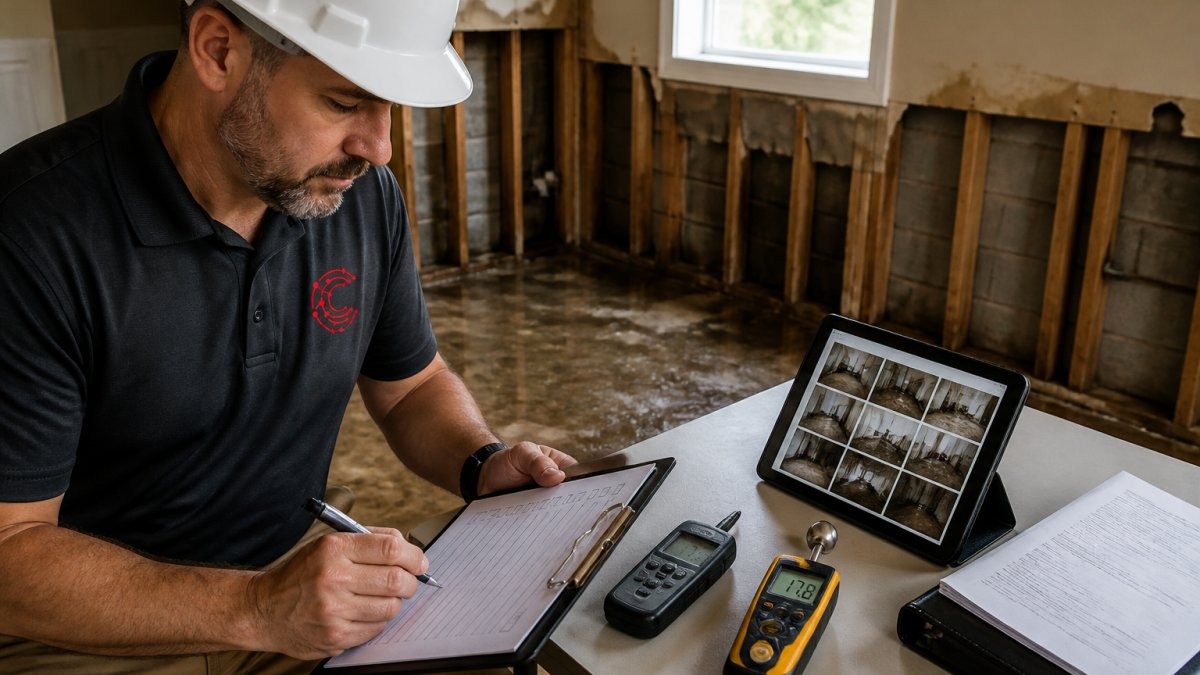
Use this checklist on every claim:
- Signed contract showing your role as general contractor
- Full scope with every trade listed separately
- Subcontractor bids and invoices for each trade
Missing items are where claims die. A common mistake is photographing damage but never photographing coordination. Carriers pay for what they can see.
Contractor Overhead and Profit Calculation: What the 10 and 10 Model Misses
Contractor overhead and profit calculation is where most estimates quietly lose money. The standard 10% overhead plus 10% profit model is treated as law, but it is only a default.
The 10 and 10 model misses real costs. It ignores office staff, software, vehicles, insurance, and the time spent managing adjusters. The Red Guide to Recovery analysis of the 10 and 10 myth notes that this allowance is often insufficient for modern restoration business costs.
Belfor Property Restoration has pushed for O&P structures beyond the standard model to keep operations viable, according to Property Insurance Coverage Law Blog coverage of O&P advocacy.
Run your own math. For a deeper walkthrough, read our guide on calculating overhead and profit margins for contractors.
Line-Item Costs Your Estimate Should Show Separately
Show these as separate lines, never bundled:
- Project management hours
- Temporary power and site protection
- Dumpster and disposal fees
Bundled costs look like padding. Separate lines look like facts.
How Restoration Job Costing Proves Your O&P Is Earned
Restoration job costing is the practice of tracking every dollar of labor, material, and equipment against a single job, so you can show what the work actually cost. That record is your proof.
When an adjuster questions O&P, you do not argue. You send a cost report. Labor hours, material invoices, equipment days, and supervision time, all tied to the job number.
Overhead tracking often breaks down when costs land in the wrong bucket, and the report cannot be trusted. If that sounds familiar, our breakdown of why restoration businesses fail to track overhead covers the usual causes. And if you want to catch costs before they eat the margin, see how to identify hidden costs in restoration jobs.
Writing an Adjuster Estimate Dispute Letter That Gets a Response
An adjuster estimate dispute letter is a written rebuttal that challenges a specific line-item reduction with evidence and a clear request. Keep it short, factual, and tied to documents.
Structure it like this:
- Claim number, insured name, and loss date
- The exact line item reduced and the amount
- Your evidence: invoices, logs, and photos by attachment number
- The correction you want, stated as a number
- A response deadline and your contact details
What to Include in the Rebuttal
Include the trade count, the coordination record, and your cost report. Attach, do not describe. One page of evidence beats three pages of argument.
Send it by email and certified mail. Keep every reply.
Follow-Up Cadence and Claim Tracking That Keeps O&P Requests Moving
Follow-up cadence is the schedule you use to chase a claim until it closes. Most O&P requests do not fail on merit. They fail on silence. The carrier is not obligated to move faster than your paper trail forces it to, so the cadence below is built to create one.
Use this cadence:
| Day | Action | Owner | Paper Trail Created |
|---|---|---|---|
| Day 1 | Send dispute letter with attachments | Admin | Email + certified mail receipt |
| Day 5 | Confirm receipt by email | Admin | Email thread |
| Day 10 | Call the adjuster, log the outcome | PM | Call log entry |
| Day 20 | Escalate to supervisor in writing | Owner | Escalation email |
| Day 30 | File a state Department of Insurance complaint if unresolved | Owner | Complaint number |
The Communication Log Template That Discourages Delay
A communication log is the single document that turns a string of emails into a record a regulator or attorney can use. Keep one per claim, and make every entry answer the same five questions:
- Date and time of contact
- Method (email, phone, portal, certified mail)
- Name and title of the person contacted
A shared spreadsheet or a project-management board works. The format matters less than the discipline of logging every contact the same day. A log with gaps is a log the carrier can attack.
Email Mechanics That Create an Enforceable Paper Trail
How you send a follow-up matters as much as what it says. A few mechanics make the record much harder to ignore:
- Keep the same subject line for the whole claim, with the claim number in it. Carriers sort by claim number, and a consistent thread is easier to produce later.
- Put the request and the deadline in the first two sentences. Adjusters skim; bury the ask and it disappears.
- Send by email and certified mail for the demand letter. Certified mail creates a delivery record email cannot.
- Reply-all to the prior thread rather than starting a new one. A single thread is a single exhibit.
- Never accept a verbal commitment without a follow-up email that restates it: "Confirming our call today, you will respond to the O&P line item by [date]."
Digital Claim Tracking Tools
Most carriers now offer a claim portal or mobile app that shows claim status, assigned adjuster, and document upload history. Use it, but do not rely on it as your only record.
A shared log with dates, names, and outcomes stops claims from going quiet. Stalled claims are usually stalled for a reason you can fix. Our guide on why restoration projects fail during insurance approval covers the common blockers.
When Unreasonable Delay Crosses Into Bad Faith: Your Regulatory Options
Bad faith is when an insurer denies or delays a valid claim without a reasonable basis. Not every slow claim is bad faith, and treating a routine backlog as bad faith burns credibility with the adjuster. The distinction matters because your remedy depends on which one you are facing.
Standard administrative bottlenecks are normal. A missing document, a backlog, a reassigned adjuster, a re-inspection.
The State Department of Insurance Complaint: The Lever Most Contractors Never Pull
Most states have a Department of Insurance that accepts consumer complaints against carriers.
Here is the mechanism.
How to file one that gets traction:
- Confirm the correct regulator. Search your state's Department of Insurance website for the "consumer complaint" or "file a complaint" page.
- Gather your paper trail first. Claim number, policy number, loss date, every written request you sent, every response (or non-response), and the specific line item in dispute. A complaint without documents is a complaint without leverage.
- State the harm in regulatory terms. Do not argue about the two-trade rule. State that the carrier has failed to respond to a written demand within a reasonable time, or has denied a covered line item without a stated basis, and cite the policy language and your evidence.
- Ask for a specific outcome. "I am requesting the department review the carrier's handling of this claim and require a written response to the O&P line item." Vague complaints get vague handling.
- Keep the complaint number. It becomes part of your file and a reference point in any later escalation.
Your Escalation Ladder, In Order
- Written demand with a response deadline (email and certified mail).
- Escalation to the adjuster's supervisor, in writing, with the prior correspondence attached.
- A complaint to your state Department of Insurance, with the full paper trail.
- Legal advice on a bad faith claim, including whether your state allows a private right of action and what the statute of limitations is.
Check your policy's coverage limits and your state's statute of limitations early. Both shape your timeline, and the limitations clock does not pause while you negotiate.
Start Recovering O&P With Cortex by JobDox
Cortex by JobDox is an AI-native operations platform built for restoration contractors. It automates documentation, predicts project budgets, and drafts adjuster responses, so O&P requests go out with evidence attached.
Three features matter most here. Automated documentation keeps your claim file complete. Budget prediction flags overruns before they hit the estimate. Adjuster response drafting turns your cost data into a rebuttal letter.
You can start a 14-day free trial and see how it fits your workflow. Reviews are available on Capterra.
Frequently Asked Questions
What does overhead and profit mean in a restoration insurance claim?
Overhead and profit (O&P) is a markup added to a restoration estimate to cover the general contractor's business costs and earnings. Overhead covers fixed expenses like insurance, office staff, vehicles, and equipment that you pay whether or not a job runs. Profit is what remains after all job costs are paid. The two-trade rule is a common carrier practice that the article discusses above.
When can a restoration contractor request overhead and profit?
Request O&P when your scope of work requires coordinating multiple trades, such as demolition, drywall, flooring, electrical, and painting. Document the trades involved, the subcontractors you will manage, and the scheduling and supervision your team provides. Carriers often reduce projects to a two-trade classification to avoid paying O&P, so your documentation must show the full trade count and the general contractor role you actually perform on site.
How do you document overhead and profit on a restoration estimate?
Build an insurance claim documentation checklist that includes the full scope with trade breakdowns, subcontractor bids, your general conditions line items, daily job logs, photo documentation with timestamps, and a job costing summary showing actual costs against the estimate. Attach a written justification explaining why the project requires general contractor coordination.
How should a contractor respond if an adjuster omits overhead and profit?
Send a written adjuster estimate dispute letter that names the omitted line items, cites the trade count, and attaches your supporting documentation. Reference the specific estimate lines the carrier removed and explain the general contractor work those lines fund. Set a response deadline in the letter and log it in your claim tracking system. If the carrier repeats the denial, escalate to a supervisor and, where state rules allow, file a complaint with the state department of insurance.
The gap between what a job costs and what a carrier pays is usually a documentation gap. Close it with a system that captures evidence on every job, not a scramble after the denial. Get started with Cortex by JobDox and recover the overhead and profit your work has already earned.