 blog
How to Use AI for Construction Insurance Claims
Last Updated: November 8, 2026
Quick Summary
You can use AI for construction insurance claims in six ways: automating intake and triage, building defensible documentation, extracting data from documents with OCR, assessing damage from photos, predicting budgets, and flagging fraud. AI sorts and flags while adjusters keep coverage, causation, and fairness decisions.
- AI triage routes claims by severity so the right adjuster handles each loss first.
- Capture evidence at the moment of discovery, before drying or debris removal destroys proof.
- Photograph moisture meter readings next to affected material and include wide shots with context.
- Construction-specific validation catches scope-to-evidence mismatches, duplicate line items, and timeline conflicts.
- Treat an AI fraud score as a question for human review, never as a denial.
Table of Contents
- Why AI Belongs in Construction Insurance Claims
- 1. Automate Claims Intake and Triage
- 2. Build Construction Insurance Claim Documentation That Holds Up
- 3. Use OCR and Document Extraction to Summarize Claim Files
- 4. AI Damage Assessment from Jobsite Photos and Video
- 5. AI Construction Estimating and Predictive Budget Control
- 6. Fraud Detection, Claim Validation, and Human Review
- Start Your 14-Day Free Trial with Cortex by JobDox
- Frequently Asked Questions
Why AI Belongs in Construction Insurance Claims
Construction insurance claims are slow, paper-heavy, and easy to get wrong.
The stakes are high. A claims file built on scattered photos and handwritten notes invites disputes.
Claims triage is the process of sorting incoming claims by severity, complexity, and urgency so the right adjuster handles the right loss first.
Here is the core argument: AI does not replace claim judgment. It removes the manual data entry, document hunting, and photo sorting that slow judgment down.
1. Automate Claims Intake and Triage
Automated claims intake captures the first notice of loss, extracts the key details, and routes the claim without manual re-keying. For construction losses, intake automation matters most during storm season, when dozens of claims land at once.
How Triage Works on a Real Construction Loss
Picture a burst pipe at a commercial build. The intake system pulls the policy number, loss date, and property address from the first call or form. It flags water damage as urgent, assigns a restoration-ready adjuster, and sends a documentation checklist to the contractor.
Three things happen at once:
- The claim file opens with structured data, not free text
- The adjuster gets a severity score and a routing recommendation
- The contractor gets a clear list of what evidence to capture
The result is fewer back-and-forth calls and a faster first response. For a deeper look at how automated first notice of loss works for carriers, see 7 Benefits of Automated FNOL for Insurance Carriers.
2. Build Construction Insurance Claim Documentation That Holds Up
Construction insurance claim documentation is the record of damage, scope, cost, and causation that supports a payout. Weak documentation is the number one reason contractors leave money on the table. Document review and predictive analysis depend on clean source records.
Good documentation has four parts:
- Photos with timestamps and location tags
- Daily logs of site conditions and work performed
- Repair estimates tied to line items, not lump sums
- A claim chronology that puts events in order
The common mistake is capturing evidence late. Once walls are dried or debris is hauled, the proof is gone. Capture at the moment of discovery, not at the end of the job.
How AI Turns Jobsite Evidence into a Defensible Claim File
Most guides stop at "take good photos." The harder problem is organizing photos, drone imagery, site logs, weather records, and project documents into one file an adjuster can follow without calling you three times. That is where AI earns its keep on construction losses.
A practical evidence-capture workflow looks like this:
- Capture at the point of loss. A superintendent photographs water staining, a project manager exports the daily log, and a drone operator flies the roof after a storm. Each item is uploaded from the field, not from the office a week later.
- Auto-tag by location and time. AI reads photo metadata and matches each image to a room, floor, or building elevation. A burst-pipe loss on the third floor stops looking like a random pile of images.
- Link evidence to line items. Each repair line, drywall replacement, flooring, dehumidification days, gets tied to the photos and logs that support it. When an adjuster questions a line, the proof is one click away.
- Build the chronology automatically. Site logs, weather records, and timestamped photos are sorted into a timeline. The file shows what happened, when, and in what order, which is exactly what a dispute turns on.
- Flag gaps before submission. The system notices a missing wide shot, an unreadable moisture reading, or a day with no log entry and prompts the crew to fill it while the site is still accessible.
Matching Evidence to Construction Loss Scenarios
The evidence set changes by loss type, and AI should prompt for the right one:
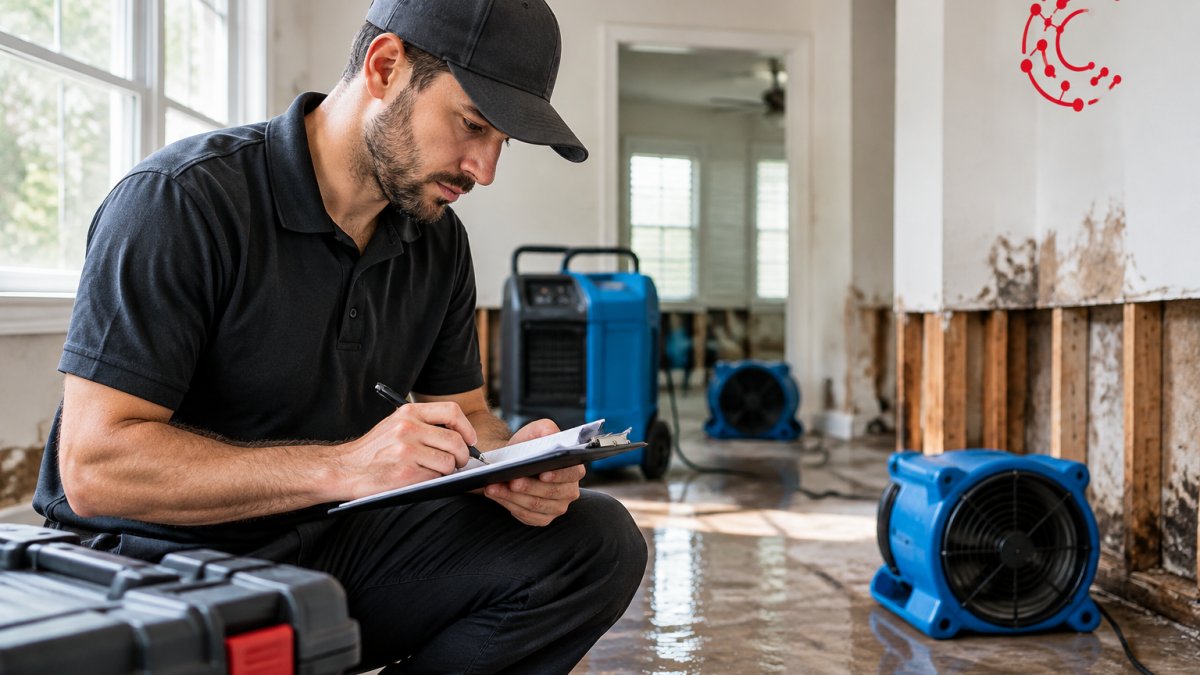
- Water damage: moisture meter readings photographed next to affected material, drying logs by day, and before-and-after shots of every demolition and drying step.
- Fire and smoke: wide shots of each affected area, close-ups of char and smoke staining, and a room-by-room inventory of damaged contents.
- Equipment loss: serial numbers, nameplate photos, purchase records, and the maintenance log for the unit.
- Jobsite injury: incident reports, witness statements, site safety logs, and photos of the condition that contributed to the event.
Watch out: capturing only close-ups with no wide context is the most common photo mistake. Adjusters cannot place damage without the surrounding scene, and AI tagging cannot fix a file that never had context.
If documentation speed is your bottleneck, our guide on how to speed up insurance claim documentation walks through seven practical steps.
3. Use OCR and Document Extraction to Summarize Claim Files
Optical character recognition, or OCR, turns scanned documents into searchable text. In construction, that means policy forms, invoices, permits, and inspection reports all become searchable in one place.
Document extraction goes further. It pulls specific fields out: policy limits, deductibles, coverage dates, and line-item totals, which cuts manual data entry.
What this changes for a contractor:
- No more retyping adjuster emails into a spreadsheet
- Faster claim summaries for settlement talks
- Fewer data-entry errors that trigger rework
A peer-reviewed review of machine learning in insurance found AI applied across risk assessment, fraud detection, and claims processing, with document handling as a shared foundation.
4. AI Damage Assessment from Jobsite Photos and Video
AI damage assessment uses image analysis to estimate repair scope from photos and video. For construction claims, a photo set can become a first-pass scope far faster than manual review.
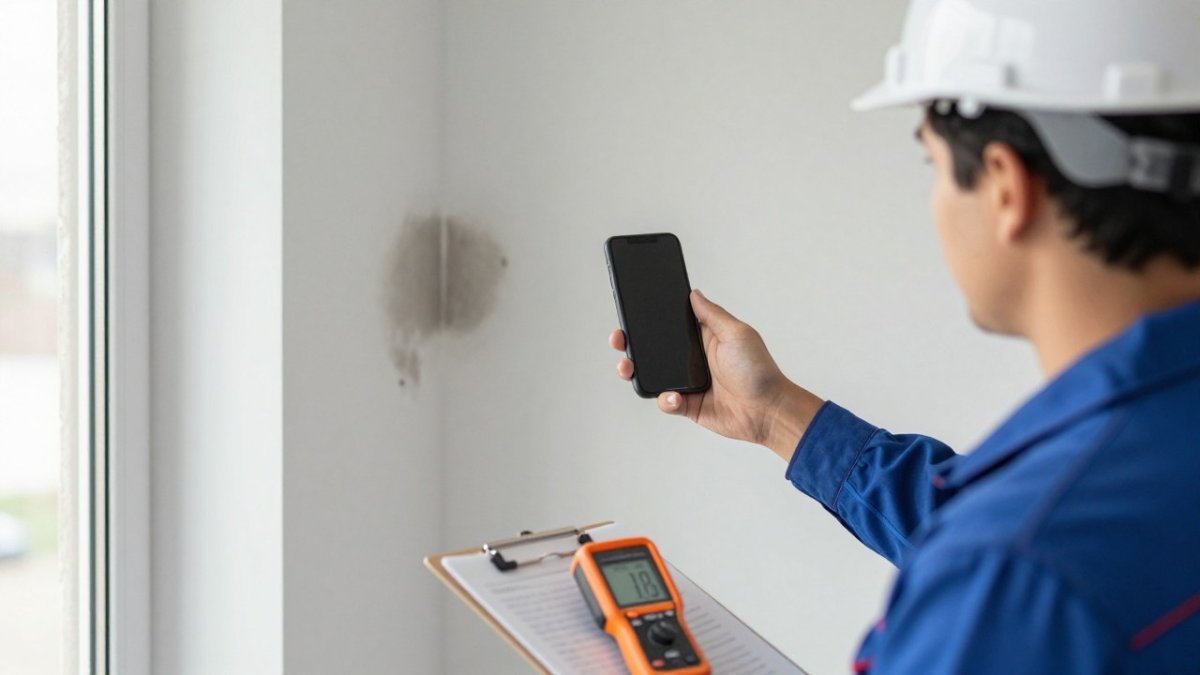
- Close-up of damage with a tape measure or reference object in frame
- Moisture meter readings photographed next to the affected material
- Timestamp and location metadata switched on
- Video walkthrough narrated with room names and findings
- Before-and-after shots for every demolition and drying step
Watch out: shooting only close-ups with no wide context is the most common photo mistake. Adjusters cannot place damage without the surrounding scene.
5. AI Construction Estimating and Predictive Budget Control
AI construction estimating builds a cost model from historical jobs and current inputs, then flags when a live project drifts off budget.
The practical difference shows up in change orders. A predictive model spots a drying job running long before the crew reports it. You can document the extra days, notify the adjuster, and support the supplement with data.
For a step-by-step walkthrough, read how contractors use AI to stop budget overruns.
6. Fraud Detection, Claim Validation, and Human Review
Fraud detection in claims uses pattern analysis to flag files that look unusual. AI compares a claim against similar losses and surfaces outliers for review.
Claim validation checks that the scope, estimate, and evidence line up. Unusually large invoices on small losses get flagged, and duplicate line items get caught.
Construction-Specific Validation Checks
Generic fraud models miss construction patterns. The checks that matter on a jobsite loss include:
- Scope-to-evidence mismatch. A line item for full roof replacement with photos showing only a few missing shingles.
- Duplicate line items across trades. The same debris-hauling charge billed by both the general contractor and the restoration sub.
- Quantity outliers. Square footage of drywall or flooring that exceeds the measured area of the affected rooms.
- Timeline conflicts. A drying log that shows equipment on site on a day the daily log says the crew was locked out.
- Estimate drift. A supplement that grows far beyond the original scope without a corresponding change in site conditions.
Each flag is a prompt for a human to look, not a denial. That distinction matters for fair treatment of policyholders.
Where Human Review Stays in Charge
AI sorts and flags. People decide. The adjuster's judgment remains essential at four points:
- Coverage interpretation. AI can surface policy language, exclusions, endorsements, deductibles, and limits, but it does not decide whether a loss is covered. That call belongs to a trained adjuster working with the policy, and often with legal or coverage counsel.
- Causation. Whether a loss was caused by a covered event or an excluded one is a judgment call that depends on facts AI cannot fully see.
- Explainability. A flag is useless if no one can explain it. Good systems show which data point triggered the alert, the specific line item, the specific photo, the specific log entry, so the adjuster can review and the policyholder can be told why.
- Bias and fairness. Models trained on past claims can inherit past mistakes. A flag that correlates with a contractor's size, region, or claim history rather than the facts of the loss deserves a second look before it affects a payout.
Watch out: treating an AI fraud score as a decision rather than a question is the fastest way to an unsupported denial, and to a dispute that costs more than the claim.
| AI Function | What It Handles | Human Role |
|---|---|---|
| Intake and triage | Routing, severity scoring | Confirms assignment |
| Documentation | Capture prompts, logs | Verifies evidence |
| OCR and extraction | Field-level data pulls | Checks key fields |
| Damage assessment | First-pass scope from photos | Confirms scope |
| Estimating | Budget forecasts, overrun alerts | Approves supplements |
| Fraud and validation | Outlier flags | Investigates and decides |
Start Your 14-Day Free Trial with Cortex by JobDox
The gap between a fast, well-documented claim and a disputed one usually comes down to process. Cortex by JobDox automates documentation and workflows, predicts project budgets, and drafts adjuster responses. White-glove onboarding is available if you want help.
If you want to see what else is out there first, our roundup of AI tools for small construction business owners covers the options. Take Cortex into the field on iPhone or Android and start your free trial today.
Most contractors lose money on claims because the evidence never makes it into the file in time.
Frequently Asked Questions
Can AI help contractors document property damage for an insurance claim?
Yes. AI tools can sort jobsite photos by room and timestamp, flag missing shots, and pull measurements and damage notes into a structured claim file. For contractors, the practical win is a complete, dated record that answers adjuster questions before they are asked, which shortens the back-and-forth on construction insurance claims.
Can AI estimate repair costs for a construction insurance claim?
AI construction estimating tools compare line items against past jobs and regional pricing to produce a starting estimate, then flag line items that look low. Treat the output as a draft, not a final number. Contractors should review quantities and scope before submission, because AI pulls from historical patterns and cannot see conditions unique to your site. Used that way, it cuts estimating time and catches omissions that slow settlement.
How can contractors use AI without compromising claim accuracy?
Keep a human in the loop at every decision point. Let AI extract data, draft summaries, and flag anomalies, then have a project manager verify scope, quantities, and code requirements before anything goes to the adjuster. Accuracy still depends on review. Document who checked what and when, so the claim file shows a clear audit trail if coverage is questioned.
How can AI organize photos and records for a construction insurance claim?
AI image analysis groups photos by location, date, and damage type, and optical character recognition pulls data from receipts, contracts, and inspection reports into one searchable file. The result is a claim chronology you can hand an adjuster: dated evidence, matching invoices, and a summary of what happened in what order.